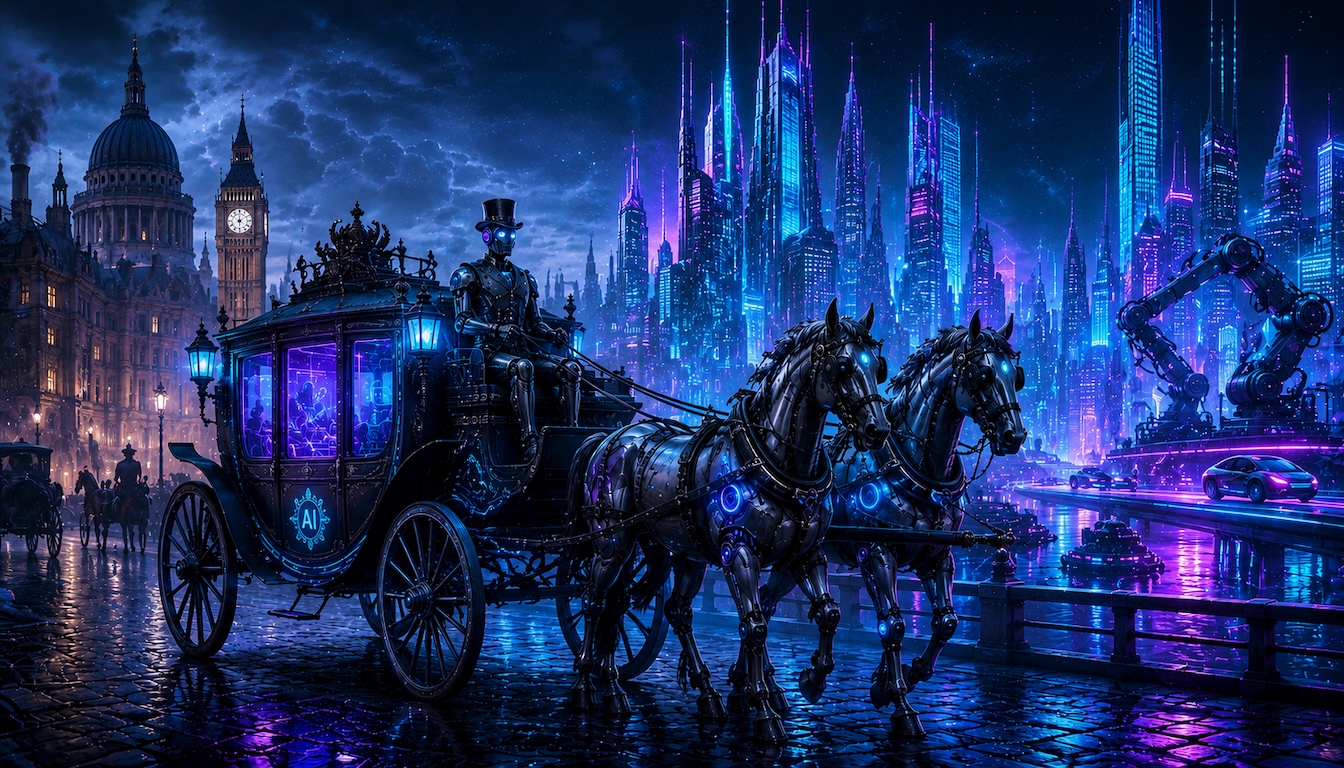
A Tale of Talos: Part 1
Of Horses, Carriages and Trains
Talos: In Greek mythology, Talos was a giant automaton made of bronze to protect Europa in Crete from pirates and invaders. He circled the island’s shores three times daily and threw stones at any approaching ship. Talos is often considered one of the earliest examples of a robot or artificial intelligence in literature, symbolizing the intersection of technology and human ingenuity.
The Era of Horse
Imagine the Wild-West era in the first years of colonization (pre 1850s). Travelling from New York state to California was not an easy task; the journey coast-to-coast was long and arduous, often taking several months to complete (an approximation of 35 to 90 days). Travelers faced numerous challenges, including harsh weather conditions, treacherous terrain, and the constant threat of bandits and wild animals. It was a tale of horses, carriages, and coachmen…
The Industrial Revolution: The Rise of the Train
Then came the train. Bigger, faster, and more reliable than any horse-drawn carriage, the train revolutionized travel and commerce across the country. With the expansion of the railroad network, travelling coast-to-coast took about a week. The train not only made the journey more comfortable but also safer, as it reduced the risks associated with long-distance travel on rough terrain. Passengers could now enjoy amenities such as dining cars and sleeping compartments, making the trip more pleasant. Additionally, the train allowed for the rapid transport of mail and goods, connecting distant communities and fostering economic growth.
Many businesess and individuals who relied on the carriage industry had to adapt or face obsolescence. Blacksmiths and carpenters in carriage-making, stable owners and horse breeders saw a decline in demand for their services. But on the other hand, new opportunities arose in the railroad industry. Jobs in rail construction, engine and wagon manufacturers, railroad maintenance and operation became available, attracting workers from various backgrounds. The coachman became the train driver, the carpenter started constructing wagons instead of carriage wheels, and the horse breeder became an engineer. Chefs, waiters, and hospitality staff catering to the needs of passengers were introduced to a mixture of new services offered to travellers to make the journey more pleasing and comfortable.
Every new technological advancement brings about a shift in the economy and workforce. The transition from carriages to trains is a prime example of how innovation can disrupt traditional industries while simultaneously creating new opportunities. As society continues to evolve, it is essential for individuals and businesses to adapt to these changes, embracing new technologies and finding ways to thrive in an ever‑changing landscape. Sometimes change happens naturally over successive generations, when the younger, born or growing during the switch, consider the new technology an essential part of their lives.
A New Frontier: Artificial Intelligence
And now we stand (once again) at the turn of a new technological advancement: Artificial Intelligence enters the scene. Just as the train revolutionized travel and reshaped the economy, AI is poised to transform various industries and redefine the way we work and live. From automation in manufacturing to advancements in healthcare, finance, and customer service, AI has the potential to streamline processes, enhance productivity, and create new job opportunities.
Technology—and, more specifically, software development—are both the birthplace and the first adopter of AI. The software development industry has been quick to embrace AI, leveraging its capabilities to improve code efficiency, automate tasks, and enhance decision‑making processes. Agentic code generation, bug detection, and predictive analytics are just a few examples of how developers are using AI to accelerate development cycles and deliver higher‑quality software products.
Every change brings turmoil in the early stages. Recent news reports show that large companies are replacing employees in favor of AI technologies. All business decisions, including those at the early stages of a revolution, are made to maximize profit and minimize cost. In other words: efficiency. If a company can achieve the same or better results with fewer employees, it is a rational business decision to reduce the workforce. But hold! There is a catch…
The initial impact of these replacements begins to reveal something different: reducing the workforce while extensively using AI‑based automation often leads to contradictory results. Token use (the “currency” used to pay for AI services) leads to higher costs; unmonitored code generation produces unmaintainable software; and the drop in the final product’s quality surrounds the process. When this happens (among many other factors), an irony emerges: more employees are need to be (re)hired to maintain and certify the quality of the code or product generated by AI, oftenly of lower quality than human work. In an other business sector, Ford has already experienced that.
Moving Forward
Trial and error brings equilibrium. In part 2 of The Tales of Talos, I will hypothesize about the evolution of modern software developers into critical, logical thinkers and how software will be created with agentic AI tools. We are moving toward a role in which developers guide AI to bridge the two “coasts” of analysis and implementation, traversing vast distances of complexity with unprecedented speed and precision. Railroad didn’t eliminate the need for travel; it changed how we journey, and so AI will not eliminate the need for developers but instead, it will redefine the way we build and deliver premium products.
The Tale of Talos continues in Automata Rising
Last updated: 22/07/2026 19:17 by Pericles Maravelakis